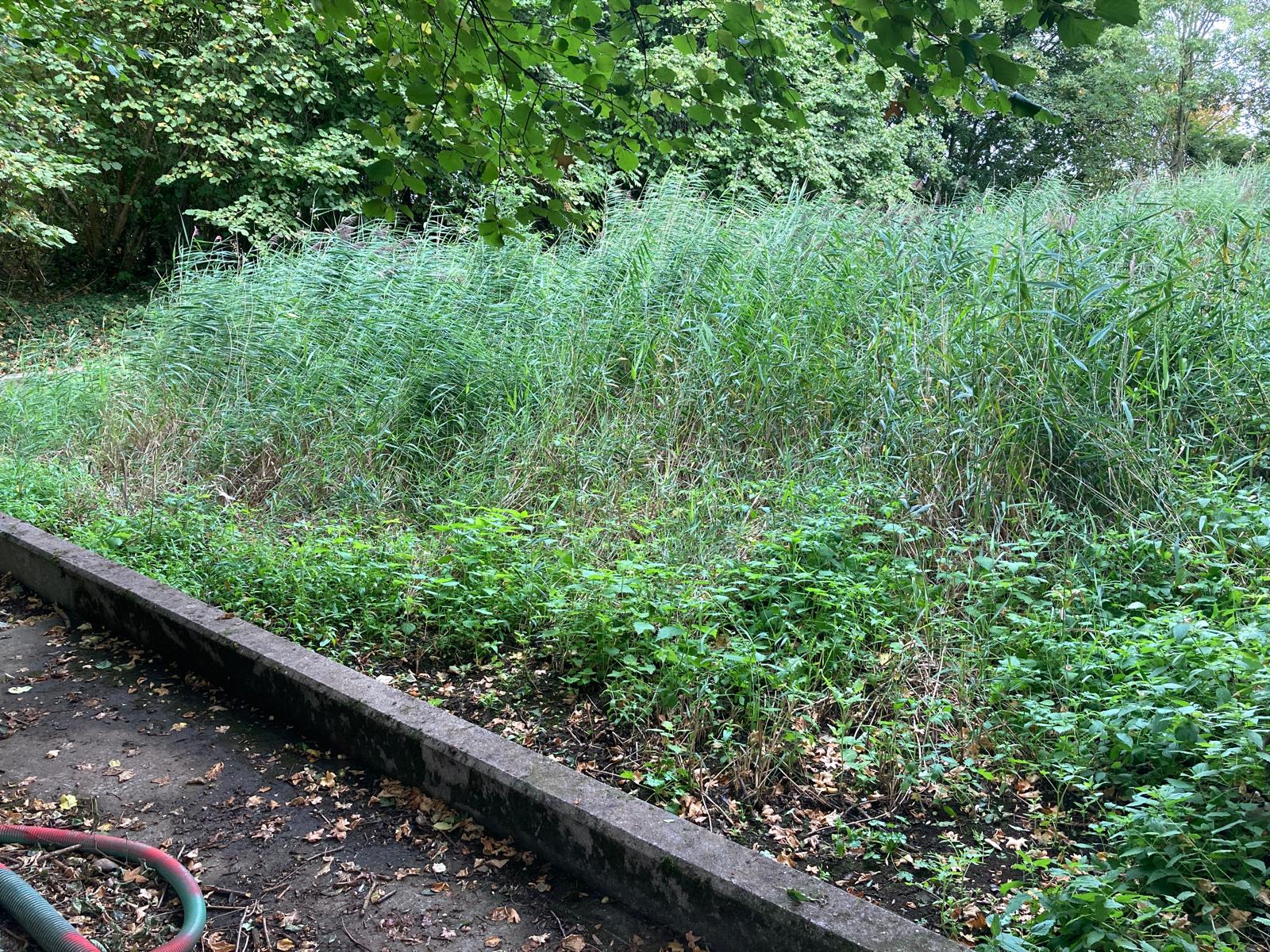
A water company approached Oren Environmental and asked the team to help recover a failing reed bed that had been taken offline to prevent pollution to nearby watercourses.
Karl Bennet is the project manager who supervised the project, which was completed within five weeks.
He discusses the challenges his team encountered and the remarkable outcome they achieved.
A costly interim solution
The reed bed was originally designed to treat wastewater before it was discharged into nearby watercourses. However, over the years, it hadn’t been maintained and had begun to deteriorate.
Consequently, our customer had no choice but to use tankers to remove the wastewater and transport it to another site for treatment. However, this was expensive and had even started to frustrate a nearby resident.
Karl explained, “Tankering had been going on for weeks, costing our customer a lot of unnecessary expense. Using large, diesel-guzzling waste tankers was also not the best environmental solution.”
The reed bed was adjacent to private fields, and the owners were unhappy with the tankering situation. The landowner complained that the noise from the tankers was disrupting his sleep and that unwanted visitors were entering his property when the gates were open.
Karl added, “He was pretty frustrated, so we explained our plans to alleviate the situation by refurbishing the reed bed, which would eliminate the need for waste tankers. In addition, we put up extra signage for visitors and installed locks on his gates. I even gave him my mobile number in case he had any concerns, telling him he could call me anytime. This definitely helped to placate him, and in the end, he was satisfied.”
Problematic pipework
One of the reasons the reed bed was failing was the condition and design of the pipework.
Karl explained, “There was an issue with the pipework, which meant wastewater wasn’t flowing evenly across the reed bed, hindering treatment. Therefore, we had to redesign the pipework to achieve optimal distribution.”
Restricted access
The reed bed is situated on a very small site with limited access, tucked behind trees and foliage. This created difficulties for the Oren Environmental team as they tried to manoeuvre the necessary machinery, equipment, and large vehicles needed to excavate the reed bed, remove its contents, and install new pipework.
Karl said, “It was like trying to get a double-decker into a kitchen! But it was nothing we hadn’t seen before. It just meant we had to choose our tools carefully and cut back some of the trees.”
Karl and his team have since created clear access paths, making it easier and safer to maintain the reed bed going forward.
Back online
After removing accumulated sludge and dead plant matter blocking water flow, replacing the pipes to ensure even water distribution, and adding new layers of gravel and fresh reeds, the reed bed was monitored to ensure the reeds established properly and that the wastewater flowed evenly through the bed.
The reed bed is now back online and working optimally, as evidenced by the samples taken by Oren Environmental and the customer’s team. Wastewater passes through the reeds and into the nearby watercourses after treatment. This now adheres to regulations and protects the local ecosystem.
Karl concluded, “We call it a thing of beauty. We’re so proud of the result—meticulously executed with care for the environment, respect for nearby landowners, and always keeping our customer’s timescales and budgets in mind.”